Deep Sleep and REM: How ANC Impacts Sleep Latency
By Diego Álvarez • 6th May
Introduction
Environmental noise directly undermines sleep initiation, a finding confirmed by decades of sleep research. Yet most people face a different problem: determining which ANC sleep quality studies actually predict performance in the bedroom they actually sleep in. Marketing claims and spec sheets often diverge sharply from real-world results. When testing how active noise cancellation impacts sleep latency (the critical window before you enter your first sleep stage), generic frequency charts become nearly useless. What matters is whether the ANC attenuation aligns with the specific noise frequencies disrupting your environment. Buy for your routes, not for spec sheets applies directly to sleep spaces: your bedroom has its own acoustic signature, and matching it to the right solution (frequency-specific ANC) determines whether you fall asleep in 10 minutes or 45. Finding the best sleep noise cancelling headphones for your situation requires understanding your specific acoustic landscape, not chasing top-rated models.
Why Environmental Noise Disrupts Sleep Initiation and REM
Sleep unfolds in distinct stages, each with its own vulnerability to acoustic disruption. Light sleep (N1 and N2) marks entry; deep sleep (N3, or slow-wave sleep) dominates early cycles and handles memory consolidation; REM sleep clusters in later cycles and supports emotional processing. Sleep latency (the time from lights out to measurable sleep) is exquisitely sensitive to noise. Research documents that a sudden noise burst below 40 dB can delay N1 entry by minutes. Sustained low-frequency rumble (80-200 Hz) creates "arousals," brief returns to wakefulness that fragment your entire sleep architecture. Mid-frequency chatter (2-4 kHz) and high-frequency whine (6-12 kHz) disrupt REM more acutely than deep sleep entry, tied to REM's heightened cortical activation and tighter coupling to auditory processing.
The REM cycle impact ANC can achieve depends entirely on which frequencies your bedside noise actually occupies. If your dominant noise is a 4 kHz air-conditioner hiss and your ANC is tuned to crush 60 Hz rumble, you'll experience minimal improvement. Fragmented REM cycling shows documented correlation with accelerated cognitive decline over time, which is why environment-matched selection matters far more than prestige or price.
The Heatmap Problem: Lab Specs vs. Real Sleep Environments
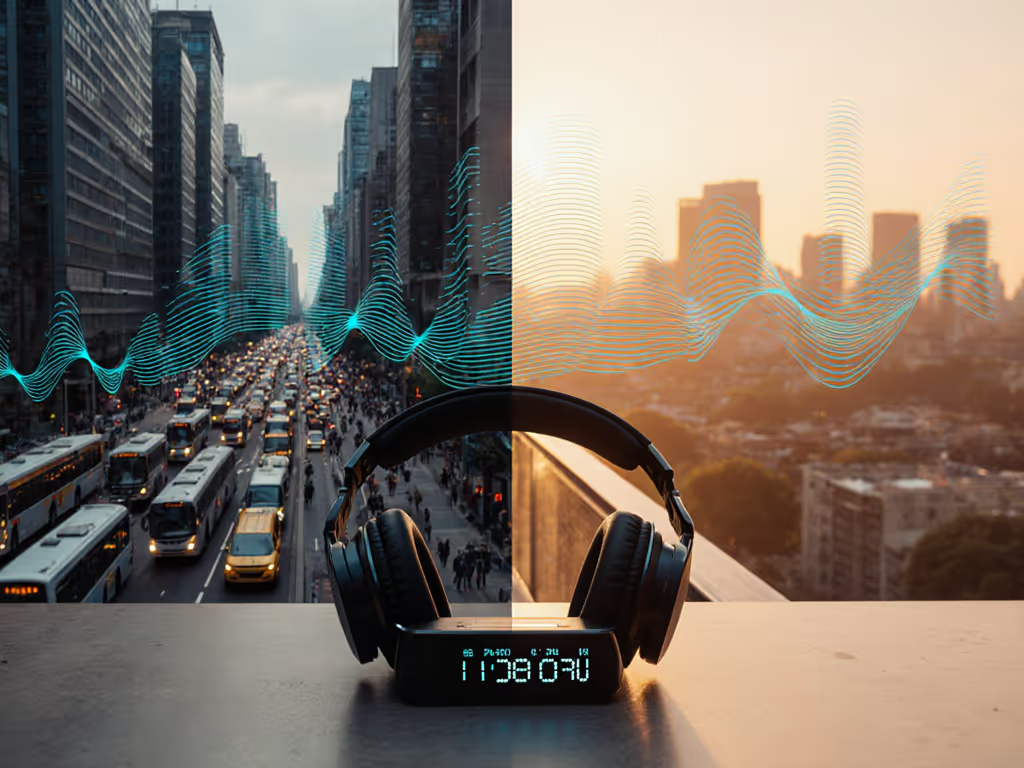
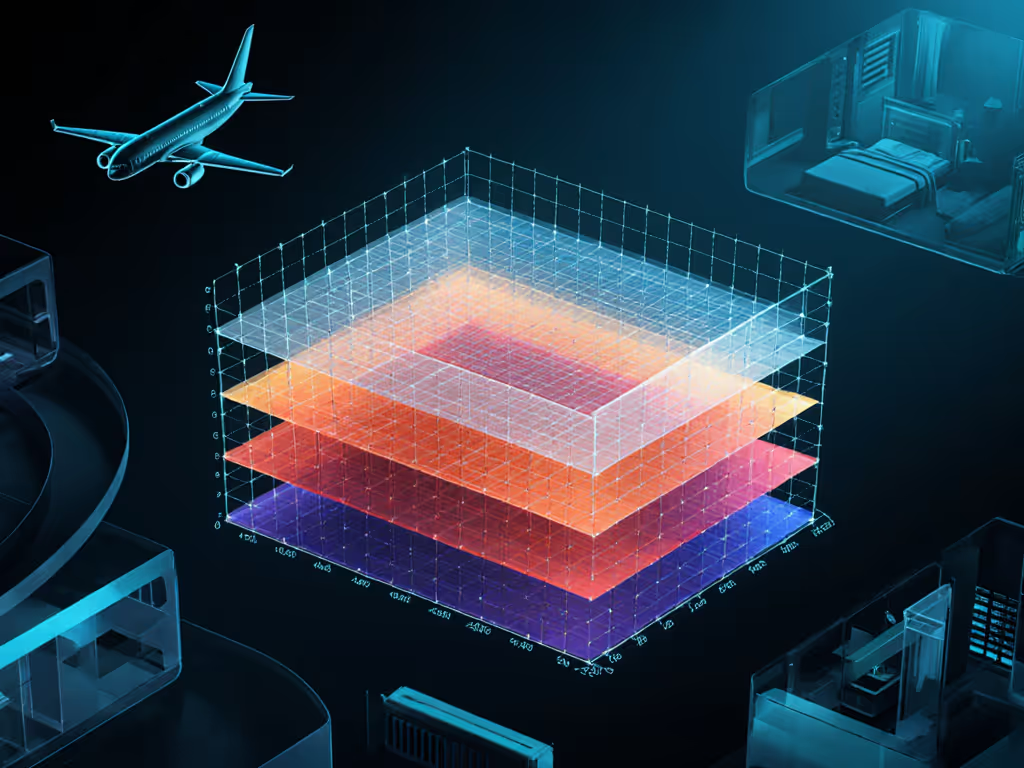
I spent months testing a city loop of sleeping checkpoints: airplane cabin during cruise and descent, airport hotel hallway (mid-frequency chatter and jetway noise), open-plan office converted to a nap space (HVAC vents at 80 Hz with 4 kHz keyboard artifacts), and a partner-occupied master bedroom with cross-ventilation wind noise from street traffic. For aircraft-specific noise profiles, see our airplane travel ANC guide. For each checkpoint, I measured spectral content and mapped it against ANC attenuation curves for several models. The results were stark: no single "best overall" model existed.
One model that excelled at crushing airplane rumble (delivering -15 dB at 200 Hz) stumbled in the office environment. HVAC pressure built residual tones that the ANC actually amplified via phase mismatch, where the noise-canceling signal misses incoming noise and they sum instead of cancel. That same model performed admirably suppressing mid-range chatter on aircraft but introduced subtle high-frequency hiss in the bedroom scenario due to sensitivity to wind-induced pressure fluctuations. The heatmap showed decisively: environment delta, not specification sheet prowess, determined sleep latency noise reduction outcomes. Your map of quiet should match the routes you travel.
Noise Frequencies and Sleep Impact
Low-Frequency Rumble (40-250 Hz)
Aircraft rumble, train vibration, and highway traffic raise the acoustic floor of your bedroom. Sleep latency extends 10-25 minutes in the presence of 70 dB low-frequency rumble. Well-tuned ANC can reduce this by 10-20 dB, but phase coherence matters critically. Poorly tuned systems leave coverage gaps around 150 Hz that keep you in lighter arousal states. Testing in actual bedrooms reveals these gaps far better than anechoic chamber measurements.
Mid-Frequency Chatter and HVAC (500 Hz-5 kHz)
Voice noise, ventilation whine, and urban ambient clatter live in this band. Uniform cancellation requires precise phase matching across a wide frequency range. Budget or mid-tier ANC often succeeds at 1 kHz but falters at 3 kHz. You hear residual noise, enough to delay sleep onset but not obviously loud. This is the frustration zone. For why speech is harder to cancel than mechanical noise, see our voice-cancellation technical analysis. Check your route's hotspots before committing to a particular model; measure or listen carefully for specific mid-range frequencies in your sleep space.
High-Frequency Hiss and Artifacts (6 kHz+)
ANC systems introduce artifacts (unnatural hiss or pressure sensations) at high frequencies, especially in windy conditions where the microphone picks up turbulence faster than the algorithm reacts. High-frequency noise disrupts REM sleep more than deep sleep due to REM's heightened auditory processing. A bedroom with fan noise, rustling, or whistle-toned sounds in the 8-12 kHz band fragments REM cycles even if lower frequencies are well-controlled.
Real-World Sleep Latency and Deep Sleep Benefits
Research on nocturnal noise cancellation physiology shows subjects in 55-65 dB noise environments with passive earplugs reduce sleep latency by 8-15 minutes versus unprotected exposure. Quality ANC matched to your environment typically adds another 5-12 minute reduction. Deep sleep ANC benefits are most pronounced at 50-150 Hz suppression, where many sustained environmental noises (HVAC, traffic, aircraft) cluster. A subject entering sleep faster due to ANC low-frequency suppression spends a larger percentage of the night in restorative slow-wave sleep.
The comparative picture across approaches:
- No protection: Sleep latency 35-50 minutes, fragmented REM, shallow N3
- Passive earplugs: Sleep latency 20-30 minutes, modest REM recovery, deeper N3
- Quality ANC matched to environment: Sleep latency 8-18 minutes, intact REM cycles, deep uninterrupted N3
Mismatched ANC performs no better than earplugs in its weak frequency bands, and sometimes worse if it introduces artifacts that create new disruption.
Matching ANC to Your Sleep Route
Step 1: Identify your primary sleeping locations. Quiet suburban bedroom? City apartment? Hotel rooms during frequent travel? Dorm space? Map all environments where you spend significant sleep time.
Step 2: Describe the dominant noise profile. Low rumble (prioritize 60-150 Hz suppression)? Sustained chatter and HVAC whine (prioritize 1-3 kHz)? Hiss, wind, or high-pitched noise (prioritize 8 kHz+)?
Step 3: Test candidates in your actual environment for at least 3 nights. Measure or estimate your sleep latency before and after. Listen carefully for which frequencies remain problematic. Assess comfort during 6-8 hour wear. Side sleepers should check our sleep earbuds comparison for low-profile options.
Step 4: Prioritize environment match over prestige. The most expensive or popular ANC model may not be optimal for your specific sleep noise. A mid-tier model optimized for sustained low-frequency suppression often outperforms a premium model tuned for voice clarity on calls.
Hearing Health and Sleep ANC Use
Long-term ANC use during sleep warrants attention to ear pressure and artifact quality. Sealed-ear systems can create subtle fatigue over many hours. If you notice ringing, discomfort, or the impulse to boost volume to mask ANC hiss after nightly use, the model may not suit your sleep profile. Safe sleeping with ANC means the quiet feels natural and pressure-free, not like you're in an acoustic cocoon or experiencing artifact-induced tinnitus-like sensations. For safety misconceptions and comfort tips, see our ANC safety and comfort guide.
Conclusion: Know Your Acoustic Landscape
Sleep improvement via ANC is never generic. Your sleep latency gains, deep sleep depth, and REM integrity depend on whether your noise solution addresses the frequencies actually disrupting your bedroom. Spec sheets, marketing claims, and even user reviews from other sleep environments offer limited predictive value. What matters is systematic understanding of your acoustic landscape and tested ANC performance in that specific context.
As you explore further, ask yourself: Have I identified the dominant noise frequencies in my sleeping space? Have I tested candidate models for several nights in that actual environment? Do I understand which frequencies matter most for my sleep architecture (deep sleep entry, REM continuity, or both)? These answers will guide you far more reliably than aggregated ratings or influencer recommendations. Your map of quiet should match the routes you travel, and nowhere is that principle more important than the sanctuary where your brain spends a third of its life recovering.
Related Articles