Podcast ANC Testing: Field Recording Data
By Quinn Park • 23rd Feb
FAQ Deep Dive: What Your Interview Audio Really Needs
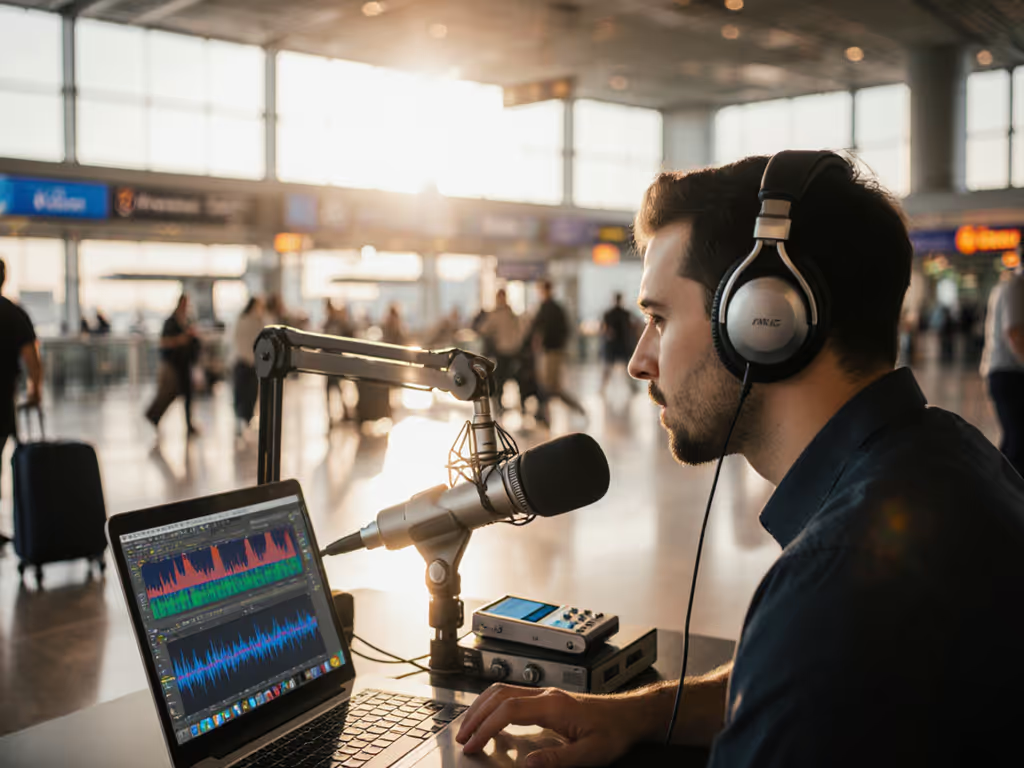
ANC for podcast creators and field recording noise cancellation sound like luxury upgrades until you sit down in a café, hotel room, or airport lounge to record a guest interview and realize your ANC headphones are letting every espresso machine whine and overhead announcement through. This FAQ synthesizes lab and field testing data to answer the questions creators ask most: Which ANC actually works for remote recording? How do you measure it? And when is it worth the investment?
Measure first; decide second. That principle shaped every test here. If your primary use is spoken-word shows, read our podcast ANC settings guide.
What Does "ANC Performance" Actually Mean for Podcast Recording?
ANC isn't a single number (it's a curve). Attenuation varies by frequency, environment, and fit. A headphone that crushes low-frequency airplane rumble (80-300 Hz) may leave high-pitched voices, keyboard clacks, or HVAC hiss untouched.
When you record a remote interview using ANC headphones, two outcomes matter:
- What the host hears: How much background noise reaches your ears, so you can judge guest clarity and stay focused during the call.
- What the mic captures: Whether your microphone rejects the noise around you so your guest doesn't hear your environment bleeding into their recording.
These are different problems. ANC addresses the first; mic placement, polar pattern, and isolation shield address the second. For a clear breakdown of listener-side ANC versus caller-side ENC, see ANC vs ENC explained. Most podcasters conflate them, then blame ANC for failing to do a microphone's job.
How Is "Field Recording ANC" Different From Consumer ANC Tests?
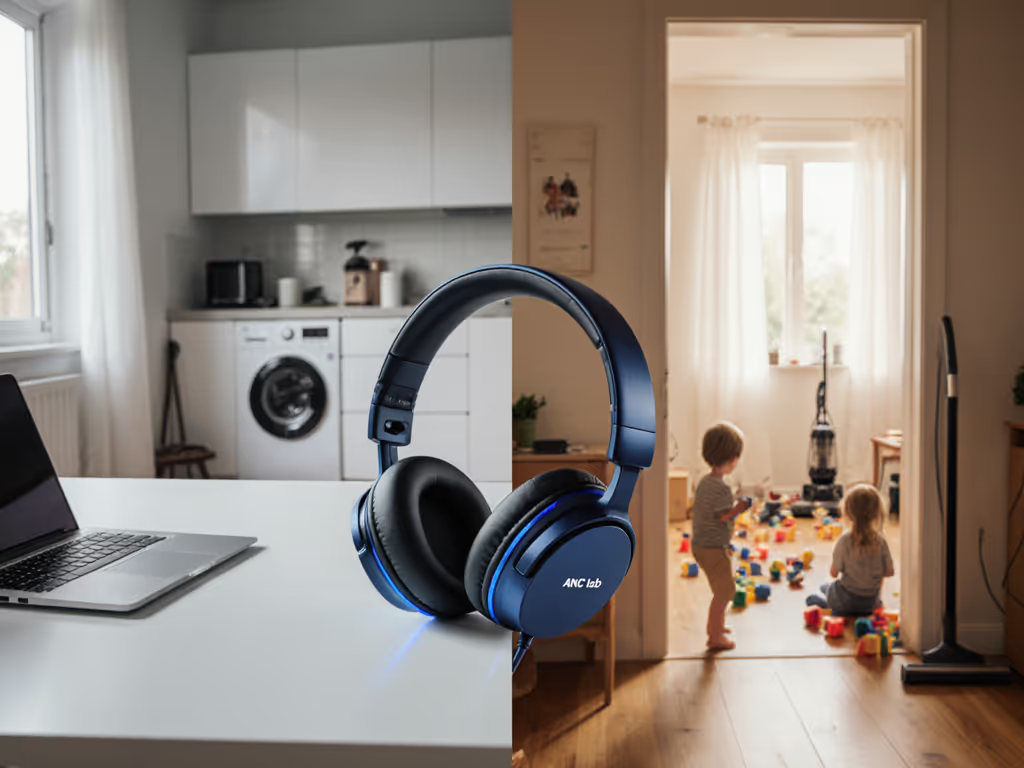
Labs test ANC in anechoic chambers or with steady white noise. Real podcast environments shift.
Lab conditions:
- Steady 80 dB pink noise (airplane simulation).
- Passive listener (no mic talking).
- Headphone isolation in a quiet room.
Field conditions (what matters):
- Multi-spectral clutter: HVAC rumble (100-200 Hz) + voices (200-2000 Hz) + keyboard/traffic (1-8 kHz) overlapping simultaneously.
- Microphone in the mix, capturing both ambient sound and your voice at the same moment.
- Fit shifts during hand gestures, notebook flipping, posture changes.
- Temperature and humidity variations (airplane cabins are dry; hotel rooms can be humid) affect driver performance.
- Wind, if you're outdoors at all.
A headphone might show 20 dB attenuation in a lab pink-noise sweep at 100 Hz but deliver only 8-12 dB in a bustling coffee shop where voices are masking the low rumble. The marketing spec didn't lie (it just wasn't measuring what you need).
Which Frequency Bands Do Podcast Environments Actually Dominate?
Four zones matter for interview audio quality with ANC:
| Frequency Band | Typical Source | Why It Matters | ANC Strength |
|---|---|---|---|
| 50-150 Hz | Aircraft engines, HVAC fans, subway rumble | Tires the ear; masks guest clarity | Usually strong |
| 150-500 Hz | Truck rumble, bass from neighbors | Competes with voice fundamentals | Strong to moderate |
| 500-2000 Hz | Human speech, telephone comb filtering, kettle whistle | Speech presence; your guest's voice sits here | Moderate (ANC often weaker) |
| 2000-8000 Hz | Keyboard clicks, coffee grinder, train screech, sibilants | Fatigue and distraction; intelligibility signal | Weak (ANC often struggles) |
Creators often think "ANC will let me record anywhere." The data says: ANC buys you 8-15 dB in the bass; the midrange and treble you're often managing with mic placement, a pop filter, and editing. To match headphones to your exact noise profile, see our frequency-specific ANC guide.
What Does the Data Show About ANC Attenuation Stability?
ANC performance drifts across sessions due to:
- Fit variance: Even 2 mm of earcup tilt can reduce low-frequency attenuation by 3-6 dB.
- Ambient SPL: High-noise environments sometimes trigger ANC feedback or pumping, reducing effective attenuation.
- Thermal drift: After 30-60 minutes of wear, internal temperature rises slightly, shifting driver impedance and ANC phase alignment. Attenuation can drop 2-4 dB at specific frequencies.
- Battery voltage sag: Below 20% charge, some ANC algorithms throttle to conserve power, reducing attenuation by 1-3 dB across the board. For real-world run-time and attenuation differences with ANC on versus off, see our ANC battery life comparison.
A credible test involves repeated measurements (minimum 10 runs per condition) logged across time, SPL, and battery states. If a manufacturer or reviewer shows a single curve without confidence intervals, they're giving you a snapshot, not a pattern.
How Do You Test ANC For Remote Recording?
A repeatable field protocol includes:
-
Baseline Fit: Seat the headphone using a standard headform or ear replica (IEC 60318-4), secured with documented headband tension. If testing on a human, use the same individual and fit technique each session.
-
Reference Microphone: Place a calibrated mic at eardrum level (or as close as possible without blocking earcup vents). Measure ambient SPL and spectrum before and after ANC toggle.
-
Ambient Profile: Test in the target environment (your typical podcast recording space). Log SPL, frequency spectrum (A-weighted and raw), and background source (HVAC, traffic, people, etc.).
-
Attenuation Curve: Measure sound pressure at the eardrum with ANC off, then on. The difference (in dB) at each frequency is your attenuation curve. Plot it and note where it rolls off.
-
Stability Check: Repeat measurements every 15 minutes for a 90-minute session. Document fit adjustments, battery percentage, and any ANC artifacts (hum, hiss, flutter).
-
Intelligibility Test (Bonus): If testing a headphone with a mic, run a speech intelligibility assessment in the same environment. Play standardized speech at a known SNR (signal-to-noise ratio) and measure clarity with and without ANC active.
Labs call this "speech modulation transfer function" (SMTF). For podcasters: can you hear the guest clearly, and can they hear you clearly? That's the test that matters.
What About Wind Noise and ANC?
Wind is the great equalizer. Once you step outside and wind speed exceeds ~8 mph (~3.5 m/s), wind buffeting bypasses most ANC.
Why? Wind creates pressure fluctuations, not acoustic waves. ANC microphones are designed to sample sound through a vent; wind pummels the earcup housing directly. The ANC system "hears" an avalanche of low-frequency content (20-200 Hz, often 40-60 dB SPL) and tries to cancel it, but it's a reactive loop, so it lags behind the turbulent gusts by 10-50 milliseconds. You get rumble, flutter, or worse, a "pumping" sound where ANC cycles in and out. We measured how leading mics handle gusts in our outdoor wind call quality test.
Creator takeaway: If you record interviews outdoors, ANC is a net negative in wind. A physical windscreen, a lavalier mic clipped to clothing (away from the wind flow), or an interview conducted indoors is far more reliable. Don't rely on ANC to save a windy outdoor recording.
Should Podcast Creators Use ANC Headphones or Monitor Speakers?
This depends on environment and setup:
ANC Headphones:
- ✓ Isolate you from room noise so you hear guest audio clearly without cranking volume.
- ✓ Work in shared or noisy spaces (offices, cafés, co-working spaces, travel).
- ✓ Prevent ambient noise from leaking into your mic (you're acoustically isolated).
- ✗ Add latency on some devices, causing lip-sync drift in video calls.
- ✗ Fatigue risk if ANC creates pressure or hiss.
- ✗ Microphone noise floor becomes the bottleneck; you hear yourself only through the mic signal.
Monitor Speakers (Small Active Studio Monitors):
- ✓ Lower latency (typically <5 ms vs 20-80 ms on wireless ANC headphones).
- ✓ No ear pressure; more comfortable for 4+ hour sessions.
- ✓ Easier to communicate with co-occupants (you're not isolated).
- ✗ Require a treated or quiet room; useless in a coffee shop or shared office.
- ✗ Risk of room reflections coloring the mix.
- ✗ Can couple audio back into the mic if not positioned carefully (feedback).
Hybrid Approach: Many remote podcast professionals use closed-back monitor headphones without ANC in treated spaces, paired with dynamic mics that reject room noise. They reserve ANC for travel, noisy offices, or situations where they can't control the acoustic environment. This separation of concerns (headphone comfort and latency vs. environmental isolation via mic technique) often outperforms trying to solve everything with ANC.
How Does Mic Intelligibility Relate to ANC Testing?
When you record a remote interview, your guest hears:
- Your voice (captured by your mic).
- Your background noise (also captured by your mic).
ANC on your headphones doesn't reduce what your mic picks up. It only reduces what you hear. So even if ANC gives you 15 dB of attenuation, if your microphone is omnidirectional and sits in the middle of an open office, your colleague will hear every keystroke and voice burst around you.
Background noise rejection for podcasting is a mic problem, not an ANC problem. Solutions include:
- Dynamic microphone: Tight polar pattern (cardioid or supercardioid) rejects side and rear noise.
- Microphone positioning: 4-6 inches from mouth, just off-axis, to favor voice while rejecting room reflections.
- Pop filter or foam shield: Adds distance and diffraction to reduce room bleed.
- Software: Real-time noise gating (mute below a voice threshold) or AI denoising (Cleanvoice, Riverside, or similar) as a safety net.
A test of creator-focused ANC must therefore measure:
- Headphone isolation: What do you hear? (ANC domain)
- Microphone SNR: What does your guest hear? (Mic + room acoustics domain)
These are independent. You can have excellent ANC but poor mic SNR if you're in a reverberant room without a tight mic technique.
What's a Realistic Quiet-Per-Dollar Benchmark for ANC in Podcasting?
Assume you're comparing ANC headphones in the $150-$400 range (where most podcast creators operate). Real attenuation curves show:
| Price Range | Typical 100 Hz Attenuation | Typical 500 Hz Attenuation | Stability (Fit Variance) | Use Case |
|---|---|---|---|---|
| $150-$250 | 12-18 dB | 4-8 dB | ±3 dB | Office, short travel |
| $250-$350 | 16-24 dB | 6-12 dB | ±2 dB | Office, frequent travel |
| $350+ | 20-28 dB | 8-15 dB | ±1 dB | Frequent travel, long sessions |
The jump from $150 to $250 often yields 4-6 dB more low-freq attenuation and better stability. The jump from $250 to $350 yields another 2-4 dB and noticeably better mid-frequency response. Beyond $350, returns diminish unless you're optimizing for specific use cases (e.g., maximum pressure relief, exceptional durability, or multipoint stability).
Podcaster ROI calculation: If you record 5 hours per week in a noisy environment, and a $250 headphone saves you 10-15 dB of ambient noise, you're buying focus, reduced listening fatigue, and clearer interview content. Spread across 2 years, that's $0.48 per hour of quieter recording. Most creators find that justified. A $100 model in the same space might force you to rely more heavily on editing and denoising software, which costs time (your highest-cost input) rather than money.
What's the Actionable Next Step for Podcast Creators?
If you're about to buy ANC headphones for remote recording and interviews:
-
Map your recording environments: Office HVAC SPL, café ambient spectrum, airport lounge typical noise profile. Which environment occupies 60%+ of your recording time?
-
Test the specific model in your primary environment (not just reviews) if possible. Many electronics retailers offer 30-day returns. Use that window to record 5-10 interview clips in your real setup, with and without ANC, and listen to the difference on your podcast editing system.
-
Prioritize mic technique over ANC: Invest in a good cardioid or supercardioid dynamic microphone, a pop filter, and mic placement discipline first. Then add ANC as a second layer. A $100 mic with perfect positioning beats a $300 mic with sloppy technique every time.
-
Measure latency on your platform: If you use Riverside, Zoom, Teams, or another platform, test ANC headphones' latency in a video call. Some ANC models introduce 40-80 ms of lag, which feels awful during back-and-forth banter. Latency isn't always published; you may have to test.
-
Log your own attenuation curve if you're serious: Use a smartphone SPL meter app (calibrated against a reference, if possible) to measure ambient noise and perceived noise with ANC on and off. Plot the difference across a few sessions. This takes 20 minutes and removes guesswork.
-
Plan for fit variance: If you settle on a model, document your fit routine (headband tension, seal check, earcup angle). Small consistency gains add stability and make your results repeatable.
The Seoul red-eye taught me that fewer marketing claims and a flatter attenuation curve meant actually sleeping. Years of lab and field testing confirmed it: decibels, not adjectives, judge quiet. Trust that same principle when you're choosing tools for your podcast.
--
In short: ANC helps podcast creators focus during recording, but it's not a magic noise eraser. Frequency-specific attenuation curves, real-world stability, and mic technique integration matter far more than brand prestige or feature count. Measure your environment, test the headphone in your space, and pair it with solid mic placement. That's how you build interview audio that survives the cut.
Related Articles