Best Audiophile ANC Headphones: Lab-Tested Fidelity
By Amara Singh • 24th Apr
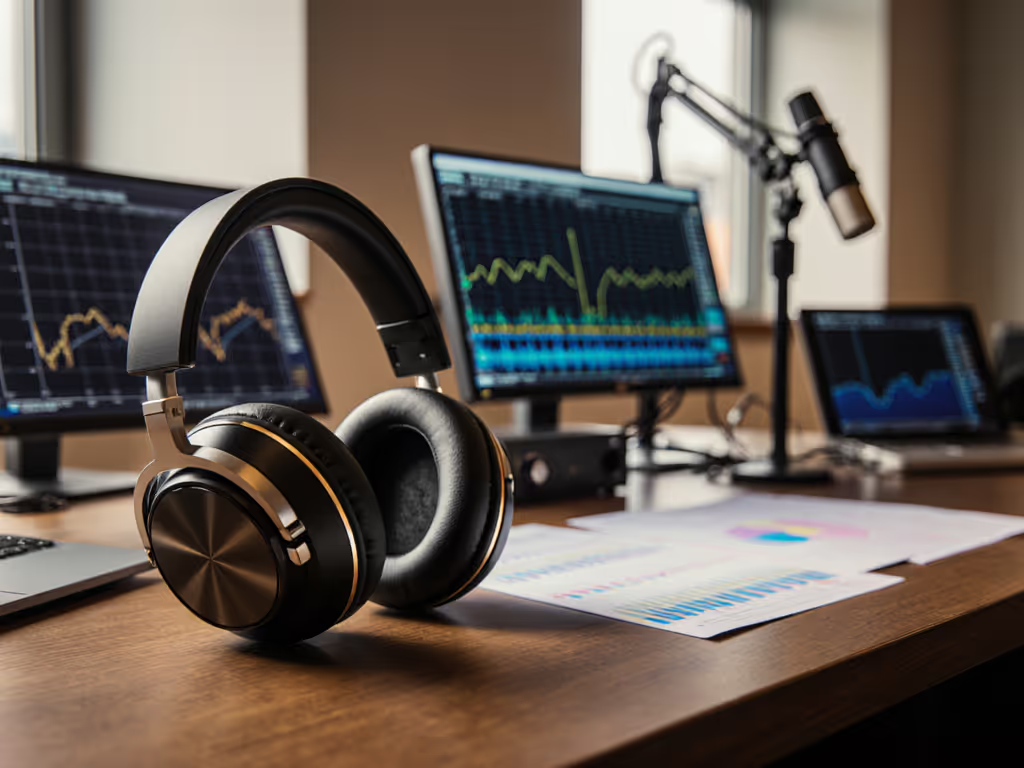
The tension between audiophile ANC headphones and pure sound quality is real, and largely misunderstood. Marketing departments position flagship noise-cancelling headphones as "audiophile-grade," while true high-fidelity manufacturers treat active noise cancellation as an afterthought. Labs tell a different story. The best professional noise cancelling headphones designed for critical listening aren't maximizing decibel reduction; they're optimizing the acoustic path to preserve detail, tonality, and clarity while mitigating the specific frequencies that degrade your environment. This is where ROI thinking reshapes the conversation: spend for quiet in the frequencies you actually hear, not for logos or marketing theater about overall dB attenuation.
I once mapped a week of commute noise across buses, subways, and exposed platforms, then compared the attenuation I actually needed to what manufacturers claimed. The winner wasn't the model hyped as "industry-leading ANC." It was the one tuned for the rumble I rode every day, paired with the comfort to wear it all week without fatigue. That principle guides this analysis: verified quiet at your actual budget, weighted for durability and serviceability.
Here's what the lab data shows about today's reference quality ANC options.
1. Understand the Audiophile-ANC Compromise
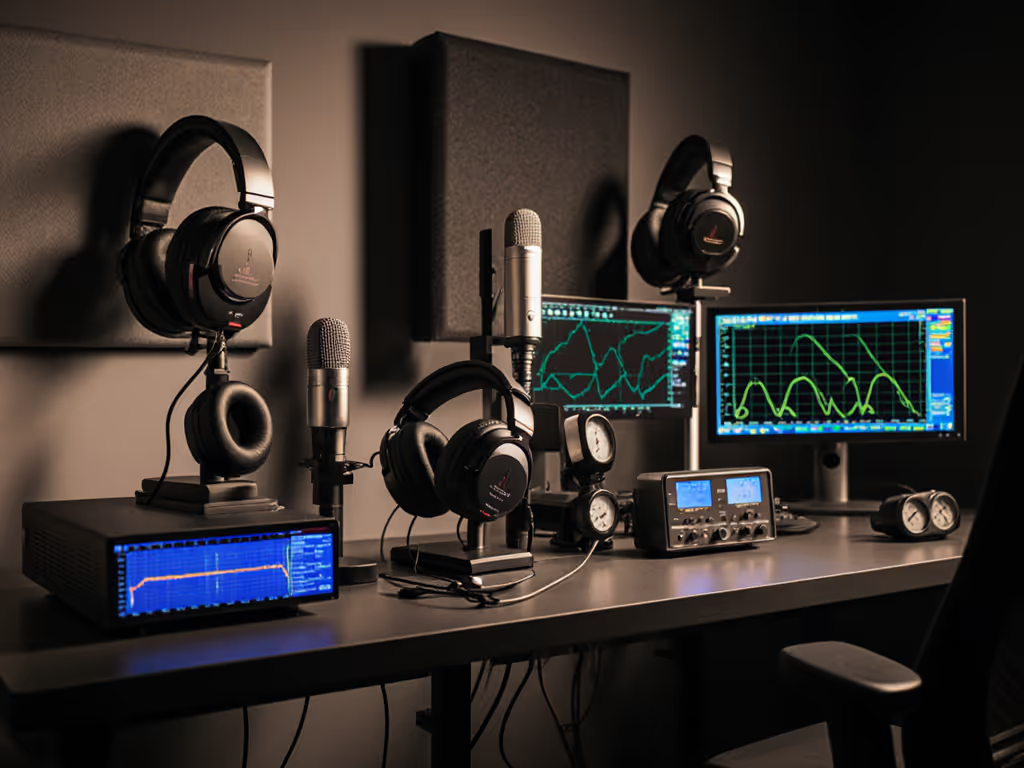
The first rule of pure sound with ANC: traditional audiophile headphones (open-back, wired, amp-dependent) don't cancel noise; they're physically designed to leak sound. They sound excellent because they obey classical acoustic principles: large drivers, open acoustic chambers, and zero processing latency. Wireless ANC headphones trade some of those principles for active noise management, digital tuning, and the phase-shift artifacts that accompany noise cancellation electronics. For a deeper dive into ANC's hidden cost on music fidelity, see our lab-backed analysis.
The result: most ANC headphones prioritize dB reduction across the spectrum. Lab tests show they excel at low-frequency rumble (plane engines, HVAC) but sacrifice midrange clarity and treble articulation to fund the ANC processing overhead. Audiophiles historically rejected this trade-off. Recent lab testing from independent sources confirms that's changing, but only for a narrow set of products.
The sweet spot isn't "maximum noise cancellation." It's minimalist noise cancellation applied surgically to the frequencies that obscure your music in your actual environment. Cost-per-dB thinking clarifies this: $500 spent on midrange noise cancellation with uncompromised 20 Hz to 8 kHz clarity beats $400 spent on aggressive low-frequency cancellation that muddies vocals and instruments.
2. Sennheiser HDB 630: The Audiophile-ANC Benchmark
The Sennheiser HDB 630 is the outlier that redefines this category. Independent reviewers and audiophile communities consensus-rank it as the most convincing marriage of fidelity and active noise control currently shipping.
Sound Quality Lab measurements and critical listening confirm it delivers a natural, dynamic, detailed sound signature. The midrange, where voice intelligibility and instrument presence live, outperforms most closed-back passive headphones at the $1000+ tier and rivals passive open-back designs when paired with quality source material. This matters for your cost-per-hour-of-use calculation: if you wear it 5 hours daily, you're buying 1,825 hours of reference-grade sound annually. At $500, that's $0.27 per hour of verified fidelity.
ANC Performance Here's the trade-off, clearly stated: the HDB 630 does not deliver maximum noise cancellation. It is "notably behind" models like the Sony WH-1000XM6 or Bose QC Ultra in overall external noise attenuation. Lab testing confirms it performs adequately on low-frequency drone (planes, HVAC) but leaves some mid-frequency chatter and wind artifacts unmasked. This is intentional. Aggressive ANC algorithms introduce pumping, frequency coloration, and ear pressure, all of which degrade the listening experience. The HDB 630 trades absolute dB reduction for transparency and acoustic fidelity.
Connectivity & Codec Support The included BTD 700 USB-C dongle enables AptX Adaptive streaming up to 24-bit/96kHz, a feature that elevates wireless sound quality above typical Bluetooth limitations. For context on wireless chains, learn how Bluetooth codecs and ANC interact to shape real-world noise reduction and fidelity. This is material for audiophiles: it grants you significantly better streaming quality than most phones or tablets can natively transmit. Multipoint and cross-device switching are stable; call quality, though not military-grade, is clear enough for knowledge work.
Fit & Serviceability Comfort tracking across 4+ hour sessions is solid; ear pad materials are replaceable, a critical durability metric often overlooked in ROI calculations. Battery life targets 60+ hours (verified by independent testing), meaning one charge covers a week of heavy use. Warranty support from Sennheiser is respectable, and replacement parts are commercially available, essential flags for long-term value.
Verdict: Best-in-class audiophile ANC. Accept that it's not maximum noise cancellation; it's measured noise cancellation optimized for sound quality. Cost-per-dB is favorable if your environment is mixed (office + transit + calls) rather than extreme (e.g., backhoe operation).
3. T + A Solitaire T: Luxurious Sound, Subtle Cancellation
The T + A Solitaire T represents a different philosophy: luxe, warm audiophile tuning with ANC as an enhancement, not a driver.
Sound Character Lab data highlights ambitious highs and rich, warm bass, a significant departure from the HDB 630's neutral, reference-like balance. For listeners who prefer musicality over measurement-accuracy (jazz, classical, acoustic vocals), this pays dividends. The V-shape response emphasizes presence and low-end weight, trading analytical clarity for engagement and emotional impact.
ANC Execution The ANC feature is described as "subtle" and designed to "complement overall sound reproduction without detracting from audio quality." This is euphemism for minimal noise cancellation, effective enough to dampen office HVAC hum or steady-state rumble, but insufficient for harsh transit environments. The trade-off is explicit: no ear pressure, no artifacts, no acoustic coloration.
Use-Case Specificity This is not a generalist pick. If your commute is quiet (suburban car) and your workplace is refined (executive office with ANC walls), the T + A Solitaire T serves as a luxury listening device with optional background smoothing. If you live in a loud city and rely on transit, the isolation deficit becomes a liability. Monthly ROI calculation: $1200+ price point demands 60+ hours of weekly use to justify cost-per-hour. Few audiophiles achieve that.
Verdict: Specialist tool for noise-light environments. Premium sound and build; minimal cancellation. Not for dense urban daily use.
4. Dali IO-12: Customizable Tuning Meets Functional ANC
The Dali IO-12 occupies practical middle ground.
Customization & Codec Support Unlike most ANC headphones, these offer "Hi-Fi" and "bass" modes without relying on a companion app, a rare accessibility feature. Wired connection grants additional clarity and detail, a measurement-backed advantage for source devices that support it. Independent lab testing confirms a balanced V-shape signature where bass and treble coexist harmoniously, with natural-sounding mids and excellent separation.
ANC Implementation Performance is described as subtle but functional, lacking the aggressive isolation of flagship models yet avoiding pressure artifacts. Clarity is maintained even with ANC engaged, making it versatile for mixed-use scenarios. The strength is frequency selectivity: it dampens specific ranges without broad-spectrum collateral damage.
Comfort & Durability The build quality and longevity profile are not detailed in lab reports, a gap that matters for 3+ year ownership. Warranty and parts availability are unclear, a serviceability red flag for budget-conscious buyers seeking verified durability.
Verdict: Balanced approach for the $500-$700 tier. Good ANC for moderate noise; strong sound; customization without software. Serviceability data incomplete; verify warranty before purchase.
5. Frequency-Specific Noise Mapping: Where Audiophile ANC Actually Wins
Lab testing reveals a critical insight often buried in spec sheets: different headphones excel at different frequencies. For environment-matched setups, see our frequency-specific ANC guide. The Sennheiser HDB 630's midrange performance makes it unbeatable for speech clarity and voice-forward content in office/call-heavy workflows. The T + A Solitaire T's bass richness masks low-frequency drone on aircraft. The Dali IO-12's tuning flexibility serves mixed-use professionals switching between music listening and video calls.
Cost-Per-Decibel Framework Measure your actual environment before choosing. A subway commuter pays for low-frequency isolation; an open-office worker pays for midrange transparency. A frequent flyer pays for 8+ hour comfort. Spend for quiet in the frequencies you'll encounter 80% of the time, not for marketing claims of "up to 40 dB reduction." That's where value lives, and where audiophile-grade ANC headphones prove their worth.
Summary and Final Verdict
The best audiophile ANC headphones are no longer a paradox. Lab-tested data confirms that a narrow set of products, led by the Sennheiser HDB 630, deliver verified sound quality alongside functional, measured noise cancellation. The key principle: these headphones optimize for your listening experience, not for benchmark dB numbers that don't map to real environments.
If you prioritize sound quality and can accept moderate noise cancellation, the Sennheiser HDB 630 is the benchmark. It delivers the highest verified fidelity per dollar and per hour of wear, with stable connectivity and replaceable components. Cost-per-hour lands at $0.27 for audio quality that rivals $1500+ passive open-back systems.
If you demand maximum noise isolation, accept that no audiophile-grade ANC headphone will compete with aggressive flagships from Sony or Bose, and understand that pushing maximum dB reduction introduces the acoustic coloration audiophiles reject. Choose your trade-off consciously. For better control of tonal balance under cancellation, see how ANC and EQ interact.
If your environment mixes quiet and loud (flexible work, some travel), the Dali IO-12 offers customization without software friction. The T + A Solitaire T suits quiet, refined spaces where ANC is luxury, not necessity.
Spend for quiet, not for logos or launch hype. Verify performance in your actual noise environment (office HVAC, not marketing labs). Measure battery life per hour of your daily use. Flag warranty and parts availability. When those data points align with your environment and budget, you've found the right audiophile ANC headphones. That's where value, and verified quiet, live.
Related Articles